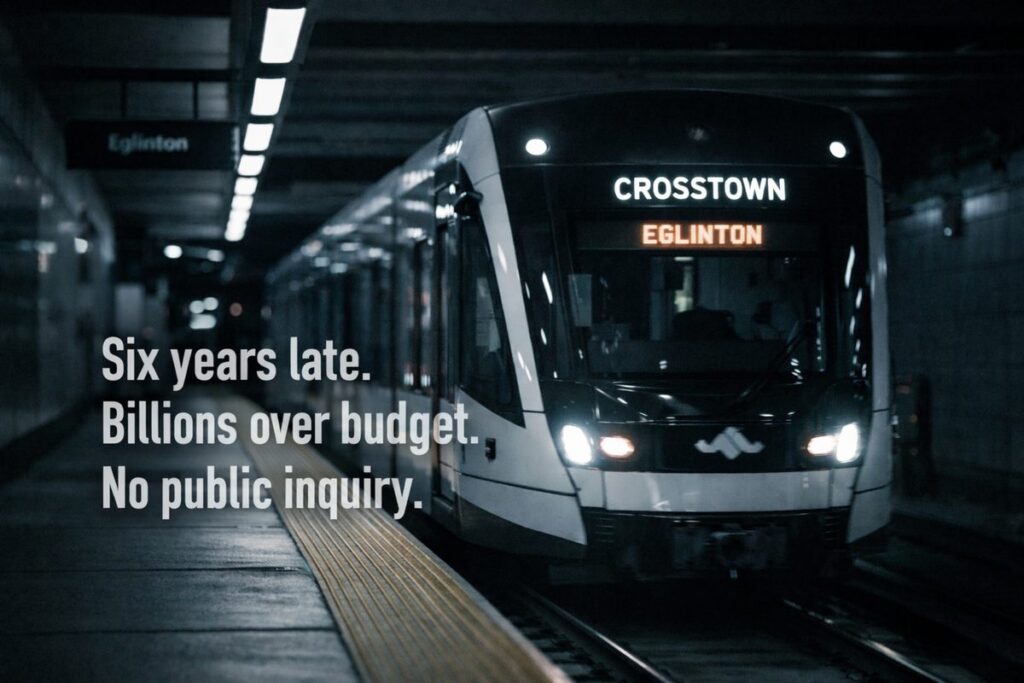
Six Years Late, Billions Over Budget — And Still No Public Inquiry
By RBT
WTFTO.ca
February 2026
TORONTO — When the Eglinton Crosstown finally opened in February 2026, government officials described it as a long-awaited milestone. For many Torontonians, however, the moment felt less celebratory and more complicated. Originally promised for 2020, the 19-kilometre light rail line arrived roughly six years late. By the time service began, estimates of its total cost had climbed toward $13 billion, depending on how lifecycle expenses are calculated. In the years between groundbreaking and opening day, construction disrupted neighbourhoods across Eglinton Avenue, strained local businesses and fueled a steady erosion of public confidence.
Construction began in 2011, with the line promoted as a transformative east–west corridor connecting Scarborough, midtown and Etobicoke. The 2020 completion target was repeated often enough to feel certain. When that deadline passed, officials cited technical complexity and coordination challenges. As 2021 and 2022 came and went without an opening date, explanations shifted toward pandemic disruptions and commissioning delays. By 2023, Metrolinx acknowledged hundreds of construction deficiencies while still unable to provide a firm timeline. Even after “major construction” was declared complete in 2024, signalling software flaws and safety certification issues continued to stall the project. The trains and stations appeared ready to the public eye, but the system itself was not cleared for service.
The financial picture evolved just as dramatically. In 2015, Infrastructure Ontario announced a contract valued at approximately $9.1 billion, a figure that included 30 years of maintenance payments to the private consortium responsible for designing, building and maintaining the line. Later reporting placed lifecycle costs closer to $12.8 to $13 billion. Earlier political messaging during the planning phase had referenced figures nearer to $5 billion. While these numbers reflect different scopes and accounting methods, the broader impression for taxpayers has been unavoidable: the cost grew substantially beyond early expectations.
Metrolinx, the provincial transit agency, oversaw the project. The primary contractor was Crosslinx Transit Solutions, a consortium that includes Aecon, ACS-Dragados, EllisDon and AtkinsRéalis, operating under a public-private partnership (P3) model. The P3 structure is intended to transfer construction and performance risk to private partners. In practice, when delays mounted, the process unfolded through contractual disputes and negotiated settlements rather than visible penalties. In December 2021, the province reached a $325-million settlement with Crosslinx related to COVID-19 impacts and technical claims. While pandemic disruptions were significant, they do not fully account for a six-year delay.
A combination of factors contributed to the prolonged timeline. Design submissions required revision years into construction, according to Ontario’s Auditor General. Structural complications were discovered near Eglinton Station. Construction deficiencies required corrective work. Software and signalling system flaws delayed commissioning and safety approvals long after physical construction was largely complete. Commissioning — the complex phase in which trains, signals, communications and safety systems must operate seamlessly together — proved to be one of the most persistent bottlenecks.
As Line 5 remained unfinished, Metrolinx proceeded with procurement and awarded major contracts for the Eglinton Crosstown West Extension in 2023 and 2024. From a governance standpoint, these were distinct projects. From a public perspective, however, the optics were difficult to ignore: the same agency managing one of Ontario’s most delayed transit builds continued awarding multi-billion-dollar contracts while the original line remained incomplete. Metrolinx CEO Phil Verster’s contract was extended in 2023 amid mounting criticism over Crosstown delays, and no senior leadership changes were directly tied to the missed timelines.
In October 2024, Toronto City Council formally requested that the provincial government launch a public inquiry into the Crosstown delays. Opposition parties echoed the call. Only the province has the authority to initiate such an inquiry, and as of the line’s opening in 2026, none has been announced. There have been audits, public statements and negotiated settlements. There has not been a comprehensive, independent examination of how the project fell so far behind schedule.
The Eglinton Crosstown will eventually carry thousands of riders daily and may prove transformative for midtown Toronto. But its legacy extends beyond transit infrastructure. It has raised lasting questions about oversight, transparency and accountability in Ontario’s megaproject system. The trains are finally running. But accountability never left the station.
loved it
there should be a investigation
Love this it is so true where is the investigation on money spent
We want an investigation!!
15 years in the making… and still not totally complete or up and running as promised. I suppose there is a bit of a disconnect between the money spent on this project, and the ballooning debt that we as taxpayer’s really ended up with. As you asked… was it all worth it. I honestly don’t think so.