



Toronto Became a Megacity. Then Somehow Forgot How to Act Like One.
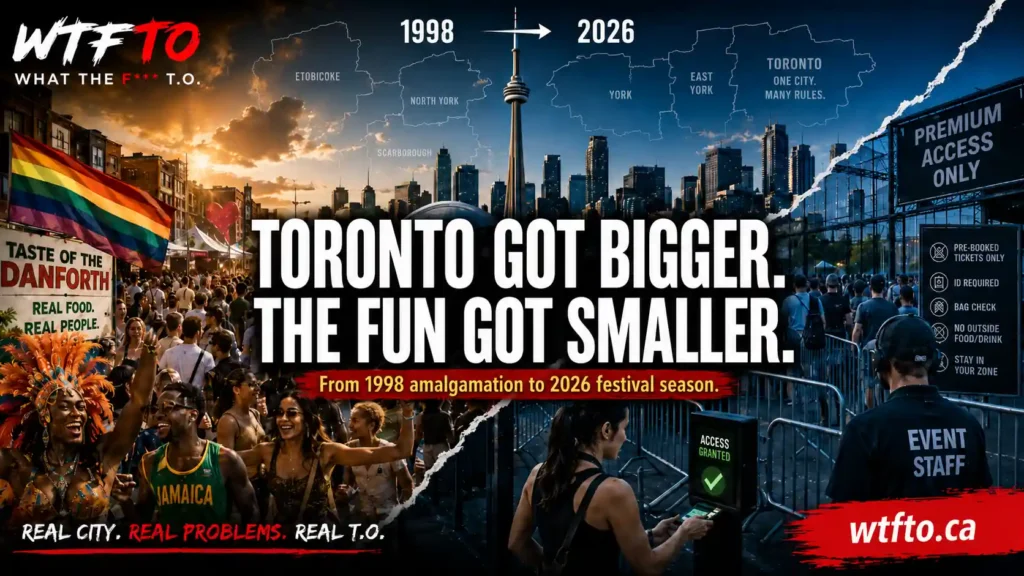
On January 1, 1998, Toronto became the “megacity.”
That was the official beginning of the new City of Toronto: old Toronto, North York, Scarborough, Etobicoke, York, East York, and Metro all folded into one larger municipal machine.
The promise was efficiency. Streamlining. A bigger city. A stronger city. One Toronto.
And in some ways, yes, Toronto became bigger.
But did it become better?
That is where things get uncomfortable.
Because somewhere between 1998 and 2026, Toronto became a city that loves calling itself world-class while proceeding like it needs permission to be interesting.
This is Canada’s largest city. It is one of the most multicultural cities on the planet. It is officially promoted as the fourth-largest city in North America. The whole world already lives here.
So why does Toronto so often feel like a city run by people who think imagination is a liability issue?
You can see it most clearly in festival season.
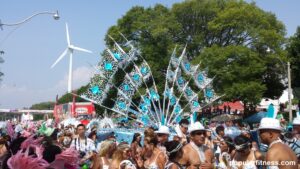
The end of spring and beginning of summer should be when Toronto wakes up. The streets should feel alive. Neighbourhoods should open up. The city should stop feeling like one giant construction notice with a tax bill attached.
And on paper, Toronto has plenty going on.
FIFA is coming. Pride is here. Toronto Caribbean Carnival — still called Caribana by plenty of people who apparently did not receive the rebranding memo — is coming. The CNE will return. Taste of the Danforth is expected back after years of trouble. Nuit Blanche still appears on the calendar. There are food festivals, street festivals, cultural festivals, sponsored stages, pop-up markets, fenced zones, ticketed experiences, premium areas, and enough “activations” to make a normal person want to deactivate.
So no, the problem is not that Toronto has no events.
The problem is that too many of them no longer feel like the city throwing open its doors.
They feel processed.
They feel managed.
They feel like fun had to submit paperwork.
Look at FIFA.
This should have been Toronto’s easiest win. The World Cup is not just a sports event here. It is practically a neighbourhood map. Every country in the tournament probably has a restaurant, bakery, barber shop, church basement, social club, grocery store, café, or community hall somewhere in the GTA ready to explode on match day.
Toronto should not have to invent World Cup energy.
It already has it.
But somehow, the conversation became access, ticketing, free versus premium, crowd control, reserved capacity, and who gets to stand where.
That is Toronto in one sentence: give us a global party, and we will find a way to make it feel like renewing a licence.
Now compare that with Vancouver.
Vancouver seems to understand that FIFA is not just about hosting matches. It is about presenting the city. The mountains. The waterfront. The public gathering place. The countdown. The fan festival. The message that says: yes, the world is coming, and yes, we actually prepared something that feels like us.
Toronto should be able to do that in its sleep.
Instead, too often, we take something huge and make it feel smaller.
That is the post-amalgamation Toronto problem.
The city got bigger, but the imagination got centralized, reviewed, budgeted, insured, branded, and quietly drained of life.
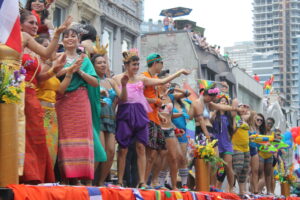
Pride is still one of Toronto’s great public celebrations. It still matters. It is still political, joyful, defiant, emotional, and necessary. But even Pride now exists in a city where major festivals have to fight rising costs, policing costs, insurance costs, security costs, barricade costs, permit pressure, and the general Toronto tradition of making everything harder than it needs to be.
Toronto Caribbean Carnival remains one of the city’s great cultural landmarks. It grew out of Caribana, with roots going back to 1967, and it still brings colour, music, movement, history, and Caribbean culture into the streets in a way few events can match.
But even there, you can feel the tension between culture and control.
The old Caribana feeling was not polished. That was part of it. It was loud, crowded, bold, sweaty, beautiful, chaotic, and unapologetic. It felt like a community taking up space.
The modern version still has power, but it also has the modern Toronto overlay: access points, fencing, viewing areas, security, branding, official language, crowd management, and the constant sense that the city is nervous about the very energy it is supposed to be celebrating.
Then there is Taste of the Danforth.
If you want a perfect example of Toronto festival decline, there it is.
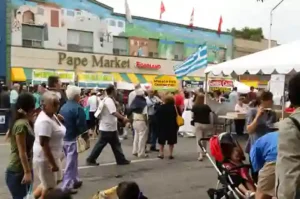
Taste of the Danforth was not complicated. That was the beauty of it. You closed the street. You walked. You ate. You bumped into people. You smelled grilled meat, heard music, saw crowds, and remembered that a main street could still belong to people instead of traffic studies and condo renderings.
It was crowded. It was imperfect. It was probably a nightmare to organize. Good. That is what a living city looks like sometimes.
Then it became a civic hostage negotiation.
Funding problems. Security costs. Medical services. Cleanup. Road design. Patio changes. Emergency access. Business levies. Government support. Will it happen? Will it not happen? Who pays? Who approves? Who gets blamed?
Toronto took one of its most obvious, beloved, simple street festivals and somehow turned it into a case study.
That is impressive, in the worst possible way.
And this is where amalgamation matters.
Before the megacity, Toronto had stronger local identities inside its own municipal structure. Scarborough was Scarborough. Etobicoke was Etobicoke. North York was North York. East York was East York. York was York. Old Toronto was old Toronto.
They were not perfect. Let’s not turn the past into a snow globe. But local identity meant something. Local politics were closer to the ground. Neighbourhood pride had a different kind of power.
Toronto even had things like the Metro Toronto International Caravan — a citywide passport of pavilions, food, music, dance, and neighbourhood-based cultural stops. It was not perfect either, but it understood something Toronto keeps forgetting: multiculturalism feels different when people can walk into it, hear it, taste it, and move through it instead of just seeing it printed in a city slogan.
After amalgamation, everything became one giant Toronto machine.
One city. One council. One budget fight. One bureaucracy. One brand.
And somehow, the bigger Toronto got, the harder it became for individual places to feel seen.
That is why the decline of festival culture matters. Festivals are not just entertainment. They are how neighbourhoods announce themselves. They are how communities say: we are here, this is ours, come walk through it.
When festivals become too expensive, too controlled, too sponsored, too fenced, too bureaucratic, the city loses more than a weekend event.
It loses memory.
It loses personality.
It loses the little moments that make people feel like they live somewhere, not just inside a municipal service area.
The CNE still survives as the emotional end of summer, even if half the experience now feels like paying airport prices to win a stuffed animal that looks disappointed in you.
Pride still fills the streets.
Carnival still brings the colour.
Taste of the Danforth may return.
FIFA will arrive with cameras, tourists, politicians, official signage, and probably enough temporary branding to cover half the waterfront.
But the question is not whether Toronto can host things.
Of course it can host things.
Toronto can host anything, as long as someone creates a steering committee, a working group, a risk assessment, a sponsor package, an accessibility plan, a premium option, and a map nobody can read.
The real question is whether Toronto can still create memories.
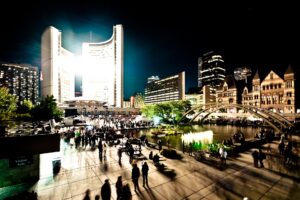
That brings us to Nuit Blanche.
And this is where Montreal makes Toronto look especially tired.
Montreal has Nuit Blanche too, as part of Montréal en Lumière. And Montreal, for all its own problems, still seems to understand that a festival should change the feeling of a city.
Montreal can take winter, darkness, food, light, art, music, walking, cold air, and public space and turn it into atmosphere.
Toronto takes an all-night art festival and too often turns it into a scavenger hunt with branding.
Nuit Blanche Toronto used to feel different.
It felt like the city had been left unlocked overnight.
You wandered around at 2 a.m. and found strange things. Some were beautiful. Some were ridiculous. Some made no sense whatsoever. But at least the city felt like it had stopped being normal for one night.
Now, some years, the strange part feels like it had to be approved by a committee first.
The artists still matter. The idea still matters. People still show up. But the old magic has thinned. Too often, you wander around trying to find the thing, only to discover the thing is smaller than expected, hidden indoors, surrounded by a lineup, or so subtle that half the crowd is wondering whether they are looking at the installation or the loading dock.
That is not always the artists’ fault.
It is the city’s fault for making big ideas feel small.
Montreal builds atmosphere.
Toronto builds instructions.
That is the difference.
And that is what this city has to face after nearly three decades of megacity life.
Amalgamation made Toronto bigger.
It did not automatically make Toronto bolder.
From 1998 to 2026, Toronto became more global, more expensive, more crowded, more branded, more developed, more managed, and more complicated.
But did it become more alive?
That is the question festival season keeps asking.
Because a city is not world-class because it says so in an economic development document.
A city is world-class when people can feel it in the streets.
Toronto has the people. It has the neighbourhoods. It has the food. It has the music. It has the artists. It has the history. It has the waterfront, ravines, laneways, old theatres, lost corner stores, immigrant stories, and communities from everywhere.
The whole world already lives here.
So why does the city so often act like the fun has to be approved, fenced, priced, and supervised before anyone is allowed to enjoy it?
Toronto became a megacity in 1998.
Now it has to decide whether it wants to act like one.
Because being big is easy.
Being alive is the part Toronto keeps messing up.
0 Comments
be respectfulNo comments yet. Start the discussion.