



The Spinning Records Everyone Remembers
There are some Toronto landmarks people remember because they were beautiful. Others because they were old. Sam the Record Man was different.…
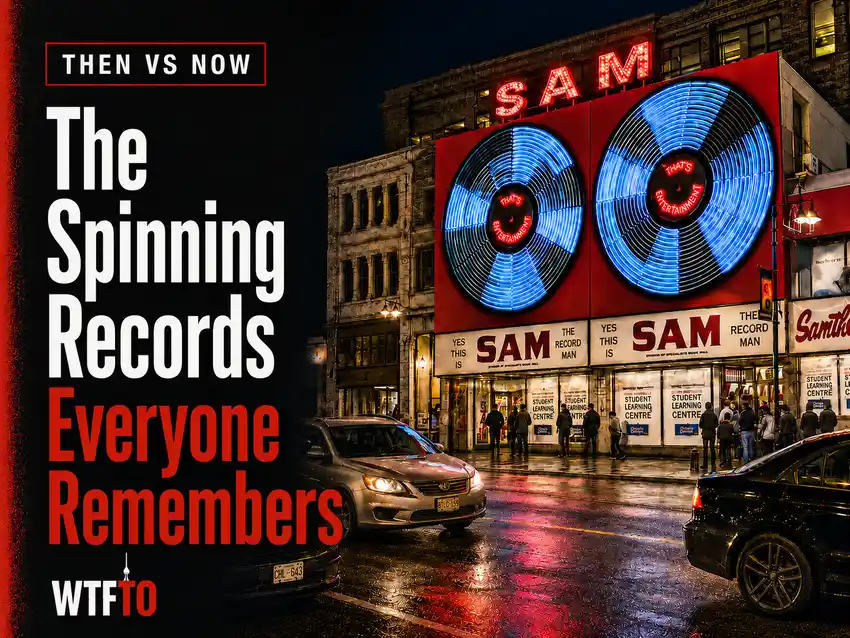
There are some Toronto landmarks people remember because they were beautiful. Others because they were old. Sam the Record Man was different.
People remember it because it moved.
The two giant neon records above Yonge Street did not just sit on the building like a normal sign. They spun. They flashed. They pulled your eyes upward. They made the block feel alive before you even walked through the door.
For generations of Torontonians, those red letters and spinning discs meant one thing: you were downtown now.
Not near downtown. Not passing through downtown. Downtown.
Sam the Record Man was the kind of landmark that did not need an explanation. You could tell someone to meet you “under the spinning records,” and they knew exactly where to go. You could be walking north from Dundas, coming out of the Eaton Centre, cutting across from the subway, or just wandering Yonge Street with no real plan, and there it was: SAM, glowing over the street like Toronto’s own jukebox.
The sign worked because it belonged to the life around it. Yonge Street was louder then, rougher then, stranger then. It had record stores, movie theatres, arcades, taverns, neon signs, buskers, cheap food, crowds, and the feeling that something might happen if you stayed out long enough. Sam’s fit that street perfectly. It was commercial, yes, but it was also public in the old Toronto way. Anyone could walk in. Anyone could browse. Anyone could disappear into the bins for half an hour and come out with something they did not know they were looking for.
That is what made the sign powerful. It was not just advertising. It was a promise.
Inside this building, music still had weight. It came in sleeves and cases. It had cover art. It had liner notes. It had smell, texture, price stickers, fingerprints, and staff recommendations. You did not scroll through Sam’s. You moved through it. You followed signs. You flipped through records. You overheard arguments. You watched someone else discover something. You took a chance on an album because the cover looked right, or because someone behind the counter knew more than you did.
The spinning records became famous because they marked the entrance to that experience.
That is why the sign still matters, even now. Plenty of old stores have disappeared from Toronto. Plenty of signs have come down. But Sam’s was different because it was tied to a shared ritual. Going there was not only about buying music. It was about going downtown to be part of something.
For teenagers, it was freedom. For collectors, it was the hunt. For musicians, it was proof that the city had a music culture. For tourists, it was a photo. For regular Torontonians, it was one of those places that made the city feel like itself.
And that is why the restored sign feels so complicated today.
It is good that Toronto saved it. Of course it is. The spinning records are part of the city’s memory, and losing them completely would have been another act of civic amnesia. But the sign was never the whole story. The sign was the doorway. The store was the place. The street was the stage.
Toronto saved the symbol after the world around it had already disappeared.
So when people look at the Sam the Record Man sign now, they are not just looking at neon. They are looking at a question Toronto still has not answered very well:
What does it mean to preserve a landmark after the life that made it a landmark is gone?
The Small Beginning: Sam Sniderman and the Record Counter
Before Sam the Record Man became a Yonge Street landmark, before the spinning records and glowing red letters, it started much more simply.
It started with records on College Street.
In 1937, Sam Sniderman began selling records through his brother Sidney’s family business, Sniderman Radio Sales and Service. This was not yet the giant store Toronto would later remember. It was a record counter inside a radio and appliance business, back when music was something people bought carefully, handled physically, and brought home like a small treasure.
That beginning matters.
Sam the Record Man did not start as a polished chain or corporate brand. It came out of old Toronto retail, where a shop could become something bigger because the person behind the counter knew the product, knew the customers, and knew how to make people feel they had found the right place.
Sam Sniderman understood that music was not just merchandise. It was taste, memory, identity and culture.
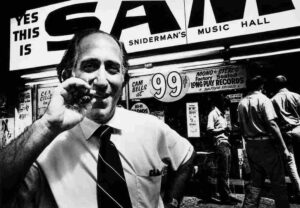
That move changed everything.
At 347 Yonge, Sam’s became more than a record store. It became part of the street. People went there before movies, after school, on lunch breaks, on weekends, on dates, or simply because they wanted to wander downtown and see what they might find.
That wandering was part of the magic.
Sam’s grew because it understood something Toronto sometimes forgets: people need places where they can linger. Places where culture feels reachable. Places where you can walk in with no plan and leave with something that feels like discovery.
It began with Sam Sniderman selling records in a family business.
It became one of Toronto’s great public memories.
The Move to Yonge Street and the Rise of the Flagship
If College Street was where Sam Sniderman learned the record business, Yonge Street was where Sam the Record Man became a Toronto legend.
The move mattered because Yonge Street was not just another address. It was the spine of downtown Toronto. It was where people went for lights, noise, movies, music, cheap food, nightlife, discovery and the feeling that they were actually downtown.
By the late 1950s and early 1960s, Yonge Street had the kind of energy Toronto does not manufacture very well anymore. It was not curated or polished into a lifestyle district. It was a working downtown street full of theatres, taverns, shops, signs, buskers, record stores, lunch counters, characters and crowds.
That was exactly where Sam’s needed to be.
In 1961, Sam the Record Man moved into 347 Yonge Street, just north of Dundas. That address became famous not because the building was grand, and not because anyone planned it as a heritage landmark. It became famous because people kept going there.
That is how real landmarks are made.
Sam’s was right in the path of the city. People passed it on their way to movies, from the subway, after school, after work, after concerts, or simply because Yonge Street was where you wandered when you wanted the city to happen around you.
The store understood that street. It was big, loud, busy and impossible to ignore. Some customers came looking for a specific album. Others came hunting for imports, jazz, rock, soul, soundtracks, comedy records or bargain-bin discoveries. Many came just to look.
And that looking was part of the culture.
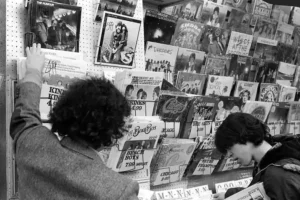
Sam’s turned that ordinary act into a downtown ritual.
As the flagship grew, it became more than a store. It was a meeting point, a tourist stop, a teenage escape, a collector’s hunt and a kind of unofficial music museum where the exhibits were for sale.
That is what the flagship gave Toronto.
It made music feel public. You did not need an invitation, a membership or a lot of money. You could walk in off Yonge Street and belong there for as long as you were browsing.
Over time, Sam’s and Yonge Street became inseparable. The sign brought people in, but the street fed the store. The crowds made it feel important. The location made it unavoidable. Every visit, every lineup, every album carried home on the subway, every memory of meeting someone under the sign added another layer.
By the time Sam’s became famous, it no longer felt like one person’s store.
It felt like Toronto’s record collection had found a home on Yonge Street.
Why Sam’s Mattered to Toronto and Canadian Music
Sam the Record Man mattered because it was never just a place to buy records.
It gave Toronto something more valuable than inventory. It gave the city a music landmark at street level. Before music became invisible, before it lived in phones, subscriptions and cloud libraries, Sam’s made music something you could walk into. You did not just search for a song. You went downtown, entered the store, moved through the aisles, flipped through the bins and let the place pull you toward something you did not know you wanted.
That was part of its power.

Sam Sniderman also understood something important about Canadian music before it was treated like an obvious thing to support. In the old record-store world, shelf space mattered. Visibility mattered. If an album was carried, displayed, recommended or talked about at Sam’s, that could mean something. It helped Canadian artists feel like they belonged beside the biggest international names, not hidden in some token corner as an afterthought.
That may sound small now, but it was not small then.
Before streaming flattened everything into a search bar, a major record store could help shape what people noticed. Sam’s gave Canadian music a public-facing platform in the middle of downtown Toronto. It helped make local and national music feel legitimate, accessible and part of everyday life.
That is why Sam’s became bigger than retail.
Not every important cultural place is a concert hall, museum, school or theatre. Sometimes culture lives in ordinary commercial spaces because ordinary people use them. Sam’s was one of those places. It was a store, yes, but it also worked like a meeting point, a listening room, a recommendation engine, a tourist stop, a teenage escape and a public memory machine.
The loss still stings because Toronto did not only lose a record store.
It lost one of the places where the city’s music culture lived out in the open.
The Fight Over the Spinning Discs
This is where the Sam the Record Man story turns from nostalgia into something more typically Toronto.
Because once the store was gone, everyone suddenly agreed the sign mattered.
That is the part that still feels ridiculous. For decades, Sam’s had been part of the life of Yonge Street. It had pulled people downtown, helped define the block, supported music culture, gave Toronto a meeting place, and became one of the most recognizable storefronts in the country. Then the business collapsed, the flagship closed, the land changed hands, and only after the actual place was finished did the city fully discover that something precious had been sitting there all along.
Classic Toronto.
We do this all the time. We let the thing die, then fight over the souvenir.
The spinning records were never just decoration. They were attached to a place people used. They were not art randomly floating over downtown. They were the front door to a store that had meaning because people actually went there. Once Sam’s closed, the sign became a problem for the city, the university, and the heritage system to manage. Not a living landmark anymore. A leftover.
That is where the hypocrisy begins.
Toronto wanted the glow without the mess. It wanted the memory without the building. It wanted the cultural credibility of Sam the Record Man without protecting the street-level culture that created it. So the city did what it often does with history: it stripped the symbol away from the life that made it important, cleaned it up, relocated it, and called that preservation.
But preservation is not supposed to mean turning a landmark into a trophy.
The original promise was supposed to mean something. The sign was not meant to vanish into storage, wait out a redevelopment cycle, and then reappear like a decorative apology. It was supposed to remain connected to the place where the memory happened. That was the whole point. People did not care about those spinning discs because they were technically interesting neon objects. They cared because those discs belonged to Yonge Street, to Sam’s, to the old downtown walk, to the ritual of saying, “meet me at Sam’s.”
Instead, the city got the usual Toronto compromise.
The store disappeared. The building disappeared. The old block was remade. The university got its new building. And the sign, after years of debate, delay and civic hand-wringing, was eventually placed on top of another building nearby, looking down on a version of downtown that had already moved on.
Yes, the records spin again.
But they no longer call anyone into Sam’s.
That is the difference between saving history and displaying evidence.
The restored sign is not meaningless. It is still beautiful. It still matters. It still deserves to exist. Losing it completely would have been worse. But we should not pretend this was some clean civic victory. It was a salvage job after the damage was done.
Toronto did not save Sam the Record Man.
Toronto saved the part it could point to.
And that is exactly why the sign feels so strange now. It shines, but it does not belong in the same way. It has become a ghost sign with electricity: bright, restored, celebrated, photographed, and slightly out of place. It tells you something was here, but it also reminds you that the thing itself was allowed to disappear.
That is not heritage at its best.
That is municipal taxidermy.
The city kept the skin and lost the animal.
The worst part is that Toronto knows how to talk about culture when it is useful. It knows how to put words like “iconic,” “legacy,” “vibrant,” “music history” and “cultural corridor” into speeches and plaques. It knows how to gather for a relighting ceremony. It knows how to thank everyone after the fight is over.
What it does not seem to know how to do is protect the fragile, ordinary places that become culture before they become nostalgia.
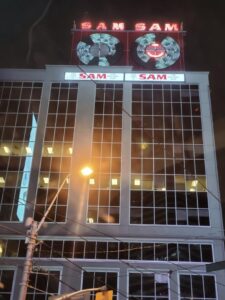
By the time the spinning records returned, The city had already made its choice.
It chose redevelopment first.
In the end, Toronto saved the sign, but not the experience. The spinning records still glow, but they sit so high above the street — detached from the store, the sidewalk, the crowds, and the old Yonge Street ritual — that you practically need binoculars to appreciate them. Why weren’t they placed somewhere lower, closer to eye level near Sankofa Square (Dundas Square), where they could have worked as a real public icon instead of a rooftop afterthought? That would have made sense: let people stand near them, meet under them, take pictures with them, and feel the old memory in the middle of the downtown crush. Instead, Toronto gave us a very Toronto kind of preservation: keep the landmark, lift it out of reach, lose the life around it, and call the job done.
0 Comments
be respectfulNo comments yet. Start the discussion.