



The Taxpayer-Funded Board That Still Won’t Fly the Pride Flag
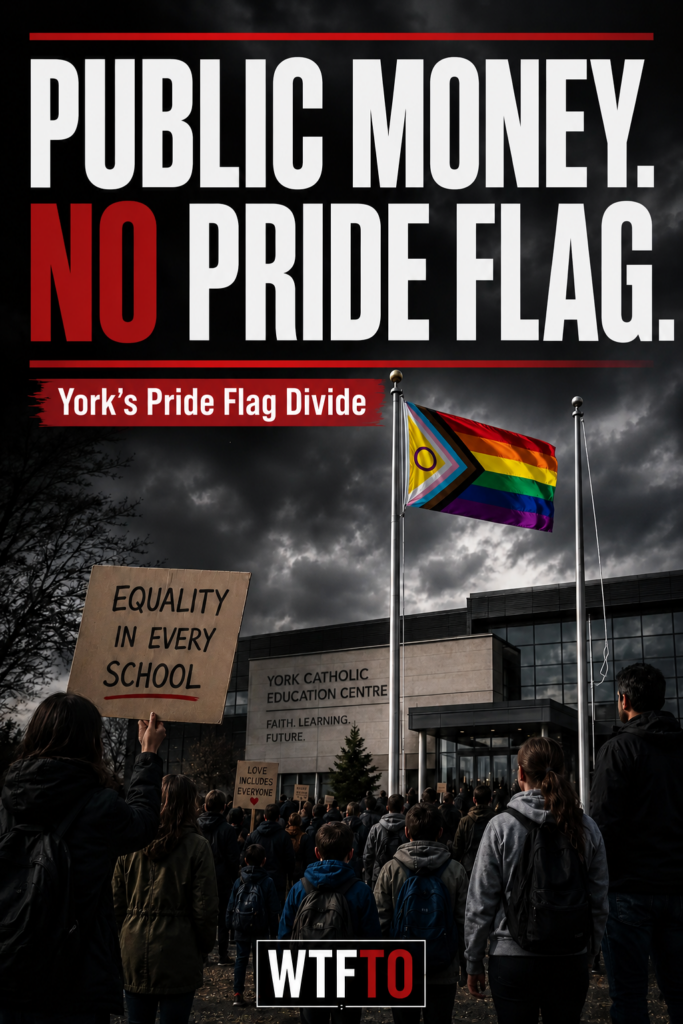
Before it became a school-board fight, the Pride flag was a signal.
It told people who had spent years being pushed to the margins that they existed, that they belonged, and that they did not have to disappear to be accepted. It came out of a long fight against silence, shame, job loss, family rejection, public ridicule, and the idea that LGBTQ people should live quietly so everyone else could feel comfortable.
That is why the flag still matters.
It is not just a rainbow on fabric. It carries the weight of people who had to fight to be seen, to love openly, to work without fear, and to demand basic dignity from governments, Hospitals, churches, schools, employers, and neighbours.
And in a school, that signal matters even more.
A Pride flag outside a school is not just decoration. To some students, it says: you are not a problem to be managed, hidden, debated, prayed around, or quietly tolerated. You are part of this place.
That is what makes York Region’s divide so hard to ignore.
In one publicly funded school system, the Pride flag flies. In another publicly funded Catholic system, trustees voted it down. Same region. Same taxpayers. Same students growing up in 2026. Two very different messages.
So this story is simple: who flies the flag, who refuses to, who voted against it, and why a publicly funded Catholic school board still gets to draw that line.
Who Flies It — And Who Does Not
In York Region’s public school system, the answer is clear. The York Region District School Board says its schools and office locations will fly the Intersex Inclusive Progress Pride Flag for Pride Month. The message is public, visible, and official.
At York Catholic, the answer is also clear, but in the opposite direction.
In May 2023, York Catholic District School Board trustees voted against a motion to fly the Pride flag outside the Catholic Education Centre in Aurora. It was not a motion to fly the flag at every Catholic school. It was a narrower request to raise it at board headquarters.
Even that was voted down.
The trustees who voted against raising the flag were Frank Alexander, Theresa McNicol, Maria Iafrate, Joseph DiMeo, Angela Saggese, and Michaela Barbieri.
The trustees who voted in favour were Elizabeth Crowe, Jennifer Wigston, Carol Cotton, and Angela Grella.
That vote is the centre of the story. Not rumour. Not confusion. Not “some people were upset.” A publicly funded Catholic school board was asked to fly the Pride flag during Pride Month. Six trustees said no.

The board’s position was not simply about flagpole logistics. York Catholic’s own flag policy already allows more than just the Canadian and Ontario flags. Its listed flag order includes municipal flags, the Vatican flag, school flags, and other organizations as approved by the Board of Trustees.
So the issue was not whether another flag could ever be displayed.
The issue was whether this flag would be approved.
The Flag Became the Line
The Pride flag did not suddenly appear in schools by accident.
Over time, school boards across Ontario began treating it as a public sign of inclusion during Pride Month. In many places, the flag became part of the normal rhythm of June: raised outside schools, mentioned in board statements, and connected to student safety, belonging, and respect.
That is why the York Catholic decision stands out.
This is not a fight from another decade. It is happening now, inside a publicly funded Catholic school system, in a province where many other boards already fly the flag without treating it as a crisis.
Even some Catholic boards have moved in that direction. For them, flying the Pride flag became a way to say that LGBTQ students and staff are not outside the community. They are not an exception. They are already there — sitting in classrooms, working in schools, and living inside the same families and neighbourhoods as everyone else.
But York Catholic drew a different line.
The board did not say LGBTQ students do not exist. It did not say they should be unsafe. It did not say they should be excluded from school life.
Its message has been more careful than that — and that is exactly why the issue is so revealing.
York Catholic’s message has effectively been this: students are welcome, but the Pride flag is not.
That is the contradiction at the centre of the story.
Because once a school board says it supports inclusion but refuses the most recognized symbol of LGBTQ inclusion, the question becomes obvious: what kind of inclusion is being offered, and who gets to decide what it looks like?
For supporters of the flag, the answer is simple. A Pride flag outside a school tells LGBTQ students that they are seen before they have to explain themselves. It tells them they are not alone before they have to ask for help. It tells them their school is willing to be public about their belonging, not just private about its tolerance.
For opponents, the flag has become a boundary. They argue that Catholic schools should express welcome through Catholic teaching, Catholic language, and Catholic symbols — not through a Pride flag.
That is where the fight really lives.
Not in the fabric.
In the message.
Whose Public School Board Is This?
This is where the issue moves beyond the flagpole.
York Catholic is not a private religious school paid for only by parishioners or church donations. It is part of Ontario’s publicly funded education system. Taxpayers pay for it. Families rely on it. Students grow up inside it. Staff build careers in it.
Its decisions are not made in some private corner of church life. They play out in public buildings, with public money, in front of public-school students.
That is why the Pride flag vote matters.
When a publicly funded board refuses to fly the most recognized symbol of LGBTQ inclusion, it is not just making a religious statement. It is making a public statement. It is telling some families that their tax dollars help fund the system, but their symbol of visibility does not belong on its flagpole.
That is a hard message to square.
Because LGBTQ students are not outsiders to the Catholic school system. They are already there. Their siblings are there. Their parents, relatives, teachers, coaches, and classmates are there. Some come from Catholic families. Some are Catholic themselves.
Some are still figuring out who they are while sitting in classrooms run by adults who are publicly debating whether a symbol of their belonging is too much to raise outside a building.
So the question becomes bigger than Catholic identity.
It becomes a public question.
Why should some families be asked to support the system with public money, but accept that their children’s inclusion must be expressed only in the language the board finds acceptable?
Supporters of York Catholic’s position argue that Catholic schools have a distinct identity, and that inclusion should be expressed through Catholic teaching, Catholic values, and Catholic symbols. That argument matters because Ontario has chosen to publicly fund a separate Catholic school system.
But public funding also comes with public accountability.
A publicly funded Catholic board cannot pretend its decisions affect only Catholics who agree with the trustees. It serves real students from real families in a real region, using public dollars.
When it refuses the Pride flag, the message does not stay inside a boardroom.
It lands on students.
Apparently, Only the Pride Flag Is the Problem
There is another layer to this.
York Catholic’s refusal to fly the Pride flag is often defended through Catholic identity. The argument is that the board has a religious character, a religious mission, and a right to express inclusion through Catholic symbols rather than Pride symbols.
But the board’s recent problems have not exactly been heavenly.
This is the same publicly funded school board that has been dealing with deficits, trustee infighting, legal-cost controversy, and provincial supervision. These are not abstract theological debates. These are taxpayer issues. Governance issues. Public-money issues.
So the contradiction is hard to miss.
When the issue is money, management, internal conflict, or legal costs, the board is clearly operating in the public world. Public dollars are involved. Public accountability is expected. Public trust is on the line.
But when the issue is the Pride flag, suddenly the line shifts.
Then the board can retreat into Catholic identity and say this particular symbol goes too far.
That is where the sarcasm writes itself.
A school board can run deficits. It can get dragged into internal disputes. It can end up under provincial supervision. It can spend public money while asking taxpayers to trust its judgment.
But the Pride flag?
Apparently, that is the line.
And that is exactly why this story matters. The issue is not whether York Catholic is allowed to have a Catholic identity. Ontario has already built an entire publicly funded system around that.
The issue is whether Catholic identity can be used to draw a public line through students and families who are also part of that system.
If public money funds the schools, public accountability has to follow.
And if LGBTQ students, staff, and families are already inside those schools, then their belonging cannot be treated like an optional decoration.
York Catholic’s Argument
To be fair, York Catholic’s position is not that students should be unsafe.
The board’s argument has been that Catholic schools already have their own symbols, language, and religious identity. Supporters of the board’s position say inclusion should be expressed through Catholic teaching, through the message of Christ, and through the cross — not through a Pride flag.
That is the line they draw.
In their view, a Catholic school board does not need to adopt every public symbol of inclusion to prove that students are welcome. They argue that Catholic education is supposed to be distinct, and that its message of dignity should come from Catholic faith, not from a flag created outside the Church.

That argument matters because Ontario does publicly fund Catholic schools as a separate system. Catholic boards are not just public boards with a different name. They exist because of a constitutional and historical arrangement that gives Catholic education a protected place in Ontario.
But that still leaves the central question unanswered.
If the board says LGBTQ students are welcome, why is the most recognized symbol of LGBTQ inclusion treated as a step too far?
A board can say the cross includes everyone. It can say Catholic teaching values every person. It can say dignity does not require a Pride flag.
But when the public board down the road raises the flag and the Catholic board refuses, the difference is visible.
And visibility is the whole point.
What the Flag Actually Says
York Catholic is not being asked to invent something no other school board has done.
Across Ontario, many public boards recognize Pride Month and fly Pride flags. The Toronto District School Board does. York Region District School Board does. And importantly, even some Catholic school boards have done it too.
The Toronto Catholic District School Board has recognized Pride Month and flown the Pride flag across its schools and board offices. Other Catholic boards, including Durham, Niagara, Ottawa, Halton, Hamilton, Peterborough, and Thunder Bay, have also moved in that direction at different points.
That matters.
Because York Catholic’s argument is not simply that Catholic schools cannot ever fly the Pride flag. Other Catholic boards have already found a way to say they are Catholic and still make LGBTQ students visible during Pride Month.
So the question remains: why not York?
Part of the problem is that the Pride flag is often treated by opponents like it is just a political banner. But that is too easy. The flag has meaning. It has history. It has layers.
The original rainbow Pride flag was created in 1978 by Gilbert Baker as a symbol for a community that had been pushed into silence and shame. It was not designed to represent a country or a government. It represented people who were fighting to be seen.
The colours were not random.
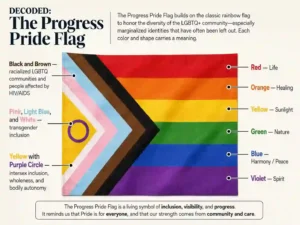
Red stands for life. Orange stands for healing. Yellow stands for sunlight. Green stands for nature. Blue has come to represent harmony and peace. Violet stands for spirit.
In the original version, Baker also included hot pink for sexuality and turquoise for art and magic. Over time, the flag changed into the six-colour version most people recognize today.
But the flag kept evolving because the struggle kept evolving.
The Progress Pride Flag added black and brown stripes to recognize racialized LGBTQ communities and people lost to, or living with, HIV and AIDS. It added light blue, pink, and white to recognize transgender people. The Intersex-Inclusive Progress Pride Flag added the yellow field and purple circle to recognize intersex people, with the circle representing wholeness, completeness, and bodily autonomy.
That is why the flag is not just decoration.
It does not represent land. It does not represent a monarch. It does not represent a government.
It represents people.
It represents survival.
It represents a long fight against exclusion, violence, silence, rejection, and the demand that some people make themselves smaller so others can feel more comfortable.
And that is why the school setting matters so much.
A Pride flag outside a school tells students something before they ever have to say a word about themselves. It tells them the building sees them. It tells them they are not an embarrassment, a controversy, or a problem for adults to debate behind a microphone.
It tells them they belong in the open.
York Catholic says students are welcome.
But when one publicly funded board raises the flag and another publicly funded board refuses, students can see the difference for themselves.
That is the part adults often miss.
Students do not experience policy as policy. They experience it as atmosphere. As silence. As signals. As what gets celebrated and what gets avoided. As which symbols are allowed to fly and which ones are treated like a threat.
That is why this cannot be reduced to a flagpole dispute.
This is about who gets to feel fully visible inside a publicly funded school system.
York Catholic has the right to explain its Catholic identity. It has the right to speak in the language of faith, dignity, and the cross.
But public money changes the conversation.
Taxpayers fund the system. LGBTQ families help fund the system. Catholic LGBTQ students sit inside that system.
So the question is not whether York Catholic can be Catholic.
The question is whether a publicly funded Catholic board can keep telling some students they are included while refusing the symbol that has come to represent their visibility.
One board flies it.
Another board still will not.
And in 2026, that refusal is no longer just a religious argument.
It is a public message.
I think this issue is important,,,