



The Ghost Projects of Toronto
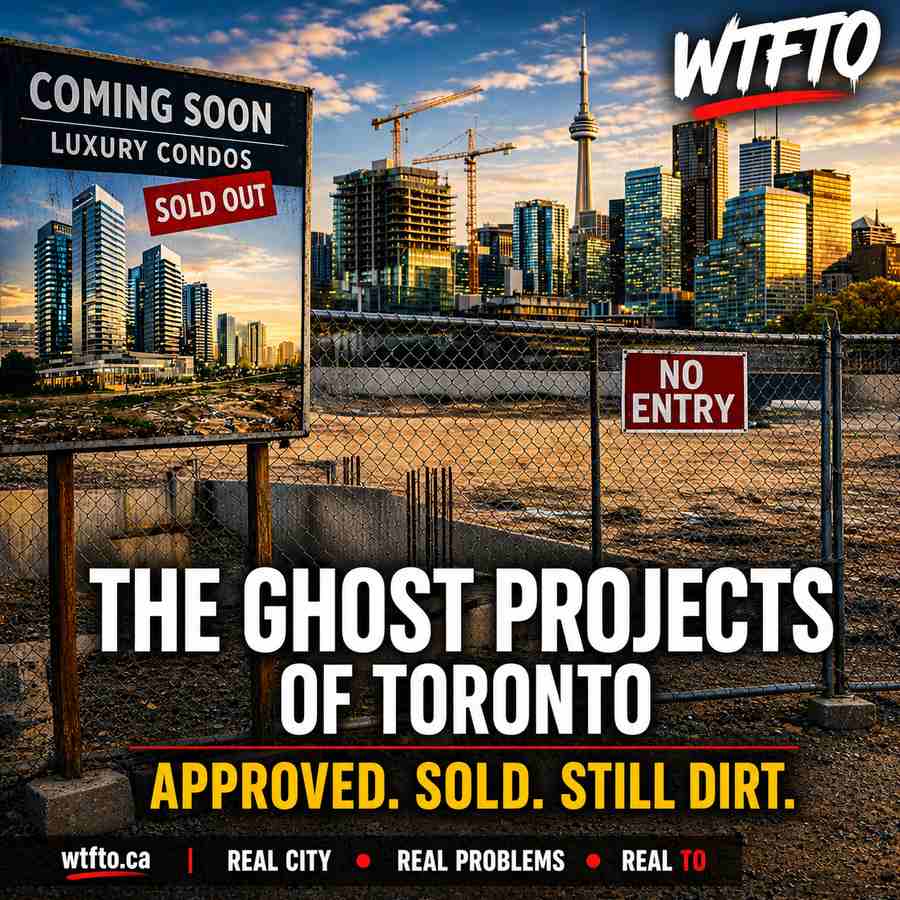
Approved. Sold. Still Dirt.
Towers promised. Deposits collected. Fences still standing
By RBT
Editor’s Note: Toronto’s housing debate often focuses on affordability, density, and approvals. This piece examines projects that were launched, marketed, and permitted, but have not moved forward as expected. This article does not allege wrongdoing. Market conditions evolve. But the gap between approval and completion deserves attention.
There was a time in Toronto when a “Coming Soon” sign felt like certainty. Renderings would appear first — sleek glass towers rising into digitally perfected sunsets. Sales centres followed, with scale models under soft lighting and agents describing curated retail, rooftop amenities, and skyline views. Buyers lined up before launch day. Deposits were wired. Units were marked sold.
Launch. Sell. Build.
For more than a decade, that was the rhythm of the city. Toronto didn’t just construct towers — it constructed inevitability.
But across the city today, a quieter pattern has emerged. In major corridors like Yonge & Eglinton, parts of the downtown core, and sections of the waterfront, there are sites that were cleared, marketed, and in some cases substantially sold — yet never meaningfully rose. Excavations remain frozen at a hole in the ground. Servicing work disrupted sidewalks and traffic, only for visible progress to stall. Fences stay up long after the marketing banners fade.
These are Toronto’s ghost projects.
A ghost project is not an abandoned building. It is something subtler — and more revealing. It is a development that secured approvals, collected deposits, and entered the public imagination, but never reached the skyline. Some have faced multi-year delays beyond original occupancy projections. Others have restructured. In certain cases, agreements were terminated and deposits returned when projects no longer met financial viability thresholds.
They exist in contracts and brochures.
But not in concrete.
The disconnect is not anecdotal. According to data from the Canada Mortgage and Housing Corporation (CMHC), the Greater Toronto Area consistently reports tens of thousands of housing units in various stages of the development pipeline — proposed, approved, or under construction. Yet there remains a measurable gap between units approved, units started, and units ultimately completed. Approval does not equal construction. Construction does not equal completion.
For years, Toronto’s pre-construction model operated in a near-zero interest rate environment. Developers relied on early buyers to secure financing. Buyers relied on appreciation in a city widely viewed as chronically undersupplied. The formula felt automatic. Projects penciled out quickly. Investor appetite was strong.
Then the math changed.
Beginning in 2022, interest rates rose sharply. Construction materials surged. Labour shortages intensified. Financing tightened. Investor demand cooled. Projects that made financial sense in 2019 did not always make sense in 2024. When margins narrow, timelines stretch. When timelines stretch too far, projects pause. And sometimes, they pause indefinitely.
This does not imply misconduct. Developers cite market conditions — and market conditions undeniably shifted. But the consequences are tangible.
For buyers, the reset is disruptive. Deposits may be returned, and legally the agreement unwinds. Yet time does not rewind. Mortgage rates may now be higher. Comparable units may cost more — or financing may be harder to secure. What once felt like a strategic foothold becomes a re-entry into a different market.
For neighbourhoods, the gap is physical. Retail space that was promised does not materialize. Housing supply that was forecast does not arrive. Sidewalks remain narrowed longer than expected. Fenced lots become semi-permanent features of the streetscape. In a city wrestling with affordability and supply shortages, stalled projects expose a tension between approvals and outcomes.
On paper, Toronto appears to have a robust housing pipeline.
On the ground, some of that pipeline is theoretical.
Toronto’s identity has long been tied to vertical ambition. Cranes symbolize growth. Glass towers reflect prosperity. The skyline still rises in many directions. But between the cranes, the unfinished spaces remain — lots cleared but quiet, permits issued but idle, expectations raised but unresolved.
This is not a story of collapse.
It is a story of hesitation.
Toronto doesn’t just build condos. It sells the future. And when that future lingers behind construction fencing, it becomes more than a market adjustment. It becomes a credibility question in a city already struggling to reconcile ambition with affordability.
Because in a housing crisis, phantom supply is not neutral. It shapes expectations, influences planning, and affects policy. It alters how supply is counted, how optimism is measured, and how communities prepare for growth that may not arrive on schedule.
The cranes are still there.
But so are the ghosts.
If you purchased into a Toronto condo project that has experienced multi-year delays, termination, or prolonged inactivity after permits were issued, WTFTO would like to hear from you. Submissions can be made confidentially.
The question isn’t whether delays happen. It’s how many are occurring, how long they’re lasting, and how that impacts buyers and communities here in Toronto.
Exactly. The issue is not that delays happen — it is how often, how long, and who ends up paying the price for them.
Wow this is something I didn’t know about. I would be interesting in hearing more
Thank you for reading. We’re glad the article brought something new to your attention, and we’ll keep covering the issue in more detail.