



The Uninsured Road: Cycling in Toronto Without Permits or Insurance
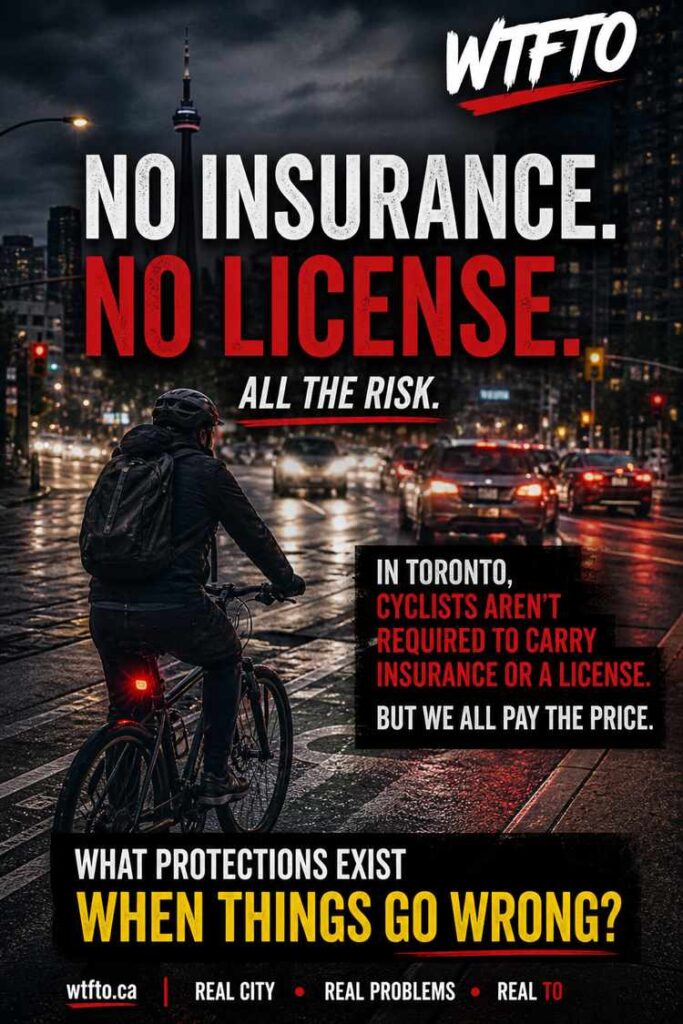
Every day in Toronto, thousands of cyclists navigate the city’s streets. Some are commuting to work, others are enjoying a scenic ride through High Park or along the Martin Goodman Trail. But behind this eco-friendly and healthy form of transportation lies a glaring legal oversight: cyclists are not required to have a permit or insurance. And while many cyclists are responsible, the absence of accountability for those who flout the rules undermines public safety and erodes trust between all road users.
No License or Permit Required: A Policy Failure
In Toronto, anyone can buy a bike and ride it on city streets without any formal training, permit, or license. This has been the status quo for decades, despite repeated proposals to introduce a licensing system. The city briefly required bike licenses from 1935 to 1957, and revisited the idea in 1984, 1992, and 1996—each time deciding against it due to administrative complexity.
But the real issue isn’t just red tape. It’s about accountability. Licensing is a proven tool to instill a basic level of responsibility and training in road users. Without it, we have created a loophole where cyclists can operate in public space with fewer expectations than any other vehicle operator.
No Mandatory Insurance: Leaving Victims and Cyclists Unprotected
Cyclists are not required to carry insurance, and the consequences of this can be dire. When accidents happen, victims are often left scrambling to recover damages. If a cyclist injures a pedestrian or damages property, they may be personally liable, but many don’t have the coverage to pay.
While drivers are required to carry insurance precisely because of the risks they pose to others, cyclists are exempt—even though a collision with a cyclist can be just as devastating. Pedestrians have been seriously injured by reckless or inattentive cycling. Who pays their medical bills? Who helps them recover lost income?
A fair system would protect everyone on the road—not just those with car insurance.
Rules of the Road Still Apply—But Are Ignored
Cyclists are legally defined as vehicles under Ontario’s Highway Traffic Act. They are required to obey traffic lights, yield to pedestrians, use lights at night, and signal when turning. And yet, enforcement is practically nonexistent.
Violations are widespread: – Cyclists running red lights or stop signs. – Riding on sidewalks, endangering pedestrians. – Ignoring basic equipment requirements like bells, lights, and brakes.
The city must do more to ensure that cyclists are not only aware of these rules but held accountable for breaking them. No one should have a free pass when it comes to public safety.
The Consequences of Inaction
This isn’t about punishing cyclists. It’s about creating a safer, more equitable road system for everyone—pedestrians, drivers, and cyclists alike. Right now, the imbalance is clear: one group is exempt from the responsibilities that every other group must shoulder.
We must demand: – Education: A public awareness campaign and basic cycling competency training. – Optional Low-Cost Insurance: Give cyclists the tools to protect themselves and others. – Targeted Enforcement: Prioritize dangerous infractions without resorting to over-policing. – Honest Policy Discussion: Revisit licensing and insurance with current data, not assumptions from the 1990s.
Conclusion: A Call to Responsibility
Toronto is on the brink of becoming a true cycling city. But we cannot get there without confronting the uncomfortable truth: a lack of rules, insurance, and enforcement leaves everyone at risk.
Cyclists deserve the freedom and benefits that come with bike-friendly infrastructure. But that freedom must be balanced with responsibility. We need policies that treat all road users fairly and protect the most vulnerable—especially pedestrians.
If we want a safer, more sustainable city, the time to act is now.
Totally agree!
Yes thank you
I Didn’t know most what is in the story..