



Hanlan’s Point Stadium: Where Toronto Got the First Swing of Babe Ruth’s Legend
Before Babe Ruth became the most famous home-run hitter in baseball history, before Yankee Stadium, before the records, before the larger-than-life legend,…
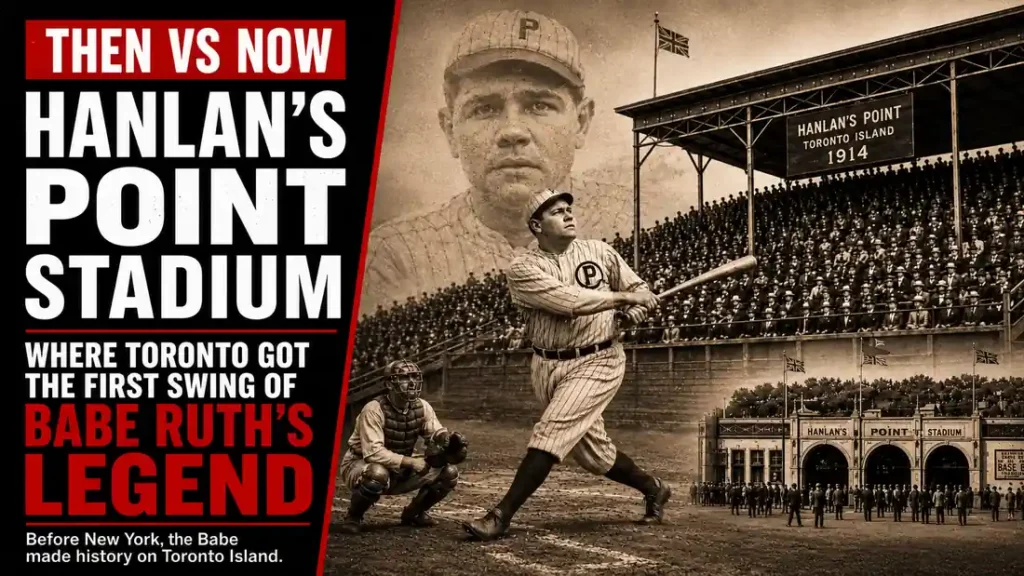
Before Babe Ruth became the most famous home-run hitter in baseball
history, before Yankee Stadium, before the records, before the larger-than-life legend, he was still George Herman Ruth — a 19-year-old left-handed pitcher trying to make his way through professional baseball. And before the Babe’s name belonged to New York, or even to Major League mythology, one of the most important swings of his life happened somewhere most people today would never expect: on Toronto Island.
It happened on September 5, 1914, at Hanlan’s Point Stadium, also known as Maple Leaf Park, on the Toronto Islands. Ruth was playing for the Providence Grays against the Toronto Maple Leafs — not the hockey team, but Toronto’s old minor-league baseball club. To the fans who crossed the harbour that day, it was just another afternoon of baseball by the lake. But by the end of the game, Toronto had quietly become part of one of the greatest sports stories ever told.
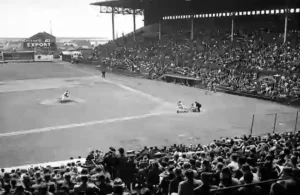
The ballpark itself was part of that forgotten world. Hanlan’s Point Stadium gave Toronto a waterfront baseball park long before today’s version of the city would ever imagine one sitting out on the Islands. The Toronto Maple Leafs baseball club played there, drawing fans across the harbour for games that mixed sport, summer, and spectacle. It was not some small empty field tucked away by the lake. It was a place where Toronto showed up.
And into that scene came a teenager who was not yet the Babe Ruth the world would come to know. In 1914, he was still George Herman Ruth, a 19-year-old left-handed pitcher trying to prove himself in professional baseball. He was not yet the Sultan of Swat, not yet the face of the Yankees, not yet the man who would change the way baseball was played. At Hanlan’s Point, he arrived as a pitcher — but Toronto was about to witness the first flash of the hitter who would become a legend.
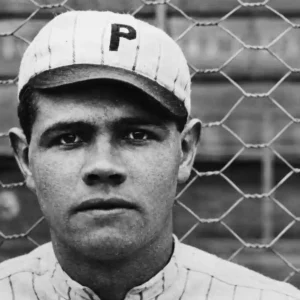
Before Ruth made history with his bat, he controlled the game from the mound. Toronto’s hitters could barely touch him that afternoon, as the young left-hander shut down the Maple Leafs and gave the home crowd almost nothing to cheer about. He was not standing there as a future home-run king yet. He was there as a pitcher, and a dominant one. By the time the game was over, Providence had beaten Toronto 9–0, and Ruth had thrown a one-hit shutout — the kind of performance that would have been memorable even if he had never picked up a bat that day.
Then came the swing that tied Toronto to Babe Ruth forever. With two runners on base, Ruth stepped to the plate against Toronto pitcher Ellis Johnson and did something few people in that ballpark could have understood in the moment. He drove the ball over the right-field fence for a three-run home run — the first professional home run of his career. It was not a Yankee Stadium blast, not a major-league milestone, not one of the famous Ruth home runs people still talk about today. It happened here, at Hanlan’s Point, in front of a Toronto crowd watching a minor-league game by the lake.
What makes the moment even stranger is that it was not just Ruth’s first professional home run — it was also the only home run he ever hit in the minor leagues. Some accounts have turned the swing into an even better piece of Toronto Island folklore, with the ball said to have carried toward Lake Ontario, as if the city itself swallowed the first piece of the Babe Ruth home-run legend. Whether the 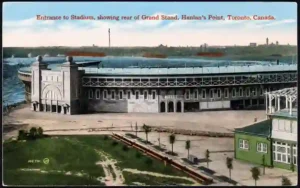
That is the strange part of the story. Babe Ruth went on to become one of the most famous athletes in the world, a name so big it eventually became part of American sports mythology. But the first professional home run of his career did not happen under the bright lights of New York, or in some grand ballpark that still stands as a shrine to baseball history. It happened in Toronto, on an island stadium that disappeared from the city’s everyday memory. Somehow, one of the greatest “who would have thought?” moments in Toronto sports history became the kind of fact most people walk past without ever knowing.
Part of the reason the story feels so hidden today is that the place itself is gone. Hanlan’s Point Stadium eventually vanished from Toronto’s sports landscape, and with it went the physical reminder of the afternoon Ruth made history. The old ballpark, the wooden stands, the ferry crowds, and the noise of baseball by the water all disappeared as the Island changed around it. What had once been a lively destination for Toronto baseball became another buried layer of the city — remembered mostly by historians, plaques, and people willing to look a little closer.
The stadium did not disappear because the Babe Ruth story was unimportant. It disappeared because Toronto changed around it. Hanlan’s Point had once made perfect sense as a summer destination, especially when baseball, amusement rides, hotels, ferries, and lakefront crowds were all part of the same attraction. But as the city grew, the Island became less practical as the permanent home of Toronto baseball. Fans still had to cross by ferry, while the mainland was filling out with roads, cars, and new development. In 1926, the Maple Leafs baseball club moved to a newer, more accessible stadium at the foot of Bathurst Street. After that, the old Island ballpark lost its purpose, its condition declined, and the land around it was eventually remade for a different Toronto altogether.
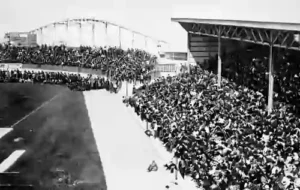
Today, there is no grandstand waiting at Hanlan’s Point, no crowd pouring off the ferry for a baseball game, and no outfield fence where people can point and say, “That’s where it happened.” The landscape has changed so much that the story almost feels impossible when you stand there now. What remains is quieter: a historical marker, a few lines of memory, and the knowledge that somewhere near that changed piece of Toronto Island, Babe Ruth’s home-run story began. For anyone who does not already know the history, it would be very easy to pass through the area and miss one of the strangest sports facts Toronto has ever owned.
Then, Hanlan’s Point was alive with baseball, ferry traffic, summer crowds, and the sound of a city gathering by the water to watch its team play. A young pitcher named George Herman Ruth walked into that scene and left behind a piece of history bigger than anyone there could have understood. Now, the stadium is gone, the crowds are gone, and the field has disappeared into a Toronto Island landscape that barely hints at what once happened there. That is what makes this story so perfect for Then vs. Now: the moment was enormous, but the evidence has almost completely vanished.
Maybe that is what makes the story feel so perfectly Toronto. The city was there at the beginning of one of baseball’s greatest legends, but the place itself faded, the stadium disappeared, and the 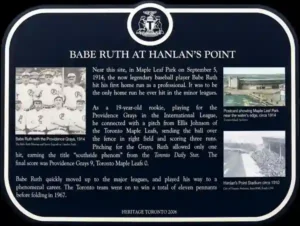
Toronto did not keep the stadium. It did not keep the ball. It barely kept the memory. But for one afternoon in 1914, before Babe Ruth belonged to New York, before he belonged to baseball mythology, his home-run story belonged to Toronto.
0 Comments
be respectfulNo comments yet. Start the discussion.